The Best Time to Visit Lake Titicaca
May to September for clear skies and calm water, with freezing nights in June and July; December to March for rain and green hills; early February for the Candelaria festival in Puno.
The best time to visit Lake Titicaca is the dry season, from about May to September: clear skies, strong sun and calm days on the water, at the price of nights close to freezing in June and July. The rains fall mainly from December to March, usually as afternoon showers, and the hills turn green. The tours to the islands run all year, so the season decides how you dress, not whether you go.
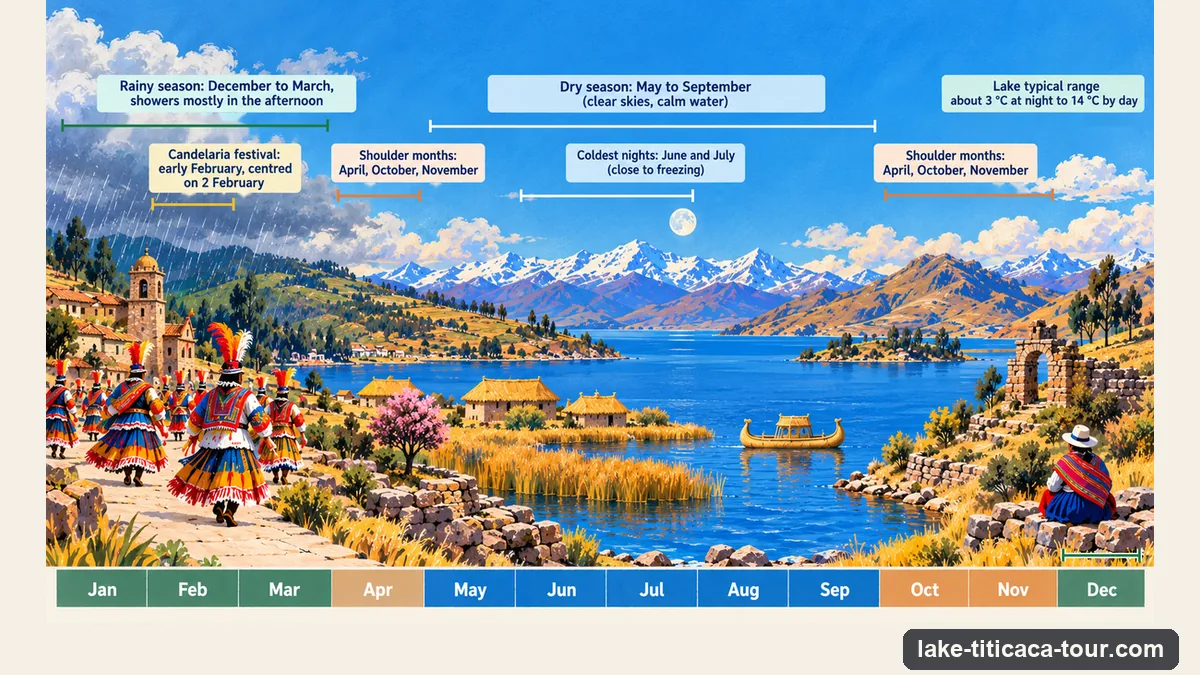
The seasons
| Months | Weather | What it means for your trip |
|---|---|---|
| May to September | Dry, clear, sunny days; cold nights, coldest in June and July | The best light and the calmest crossings; pack for frost at night |
| October and November | Warming, the first showers arrive | A good balance: fewer visitors, mostly dry mornings |
| December to March | The rainy season: showers, mostly in the afternoon | Green hills, softer light; take the boat in the morning |
| April | The rains ease | A quiet month before the dry season |
Peru’s weather service, SENAMHI, gives October to March as the rainy season around the lake, with the heaviest rain from December to March, and June and July as the months when the night-time minimum is lowest. On the lake itself the water moderates the climate: PromPerú gives Lake Titicaca’s typical range as about 3 °C at night to 14 °C by day.
Dry season: May to September
These are the months of the clearest skies, when you see the snow peaks across the lake from Taquile and the light on the reed islands is sharp. Days are pleasant in the sun and cold in the shade, and after sunset the temperature falls fast; nights in Puno can drop below freezing in June and July. This is also when most visitors come, so book the Amantani homestay and the train a little ahead.
Rainy season: December to March
Rain at the lake usually comes as showers and storms in the afternoon, after a bright morning. That suits the island tours, which leave Puno at about 7:30 and are on the water before the clouds build. The hills and terraces are green, and there are fewer visitors. Pack a rain jacket and dry layers, and expect the odd crossing to be choppy.
February: the Candelaria festival
Every February Puno holds the Festivity of the Virgen de la Candelaria, centred on 2 February, with dance groups in costume and masks filling the streets. UNESCO inscribed it as intangible heritage in 2014. It is the liveliest time to be in Puno and the hardest time to find a hotel; book early if your dates fall in early February.
So when should you go?
- For the weather: May to September.
- For fewer people and mild weather: October, November or April.
- For the festival: early February.
- Whenever you can: the island tours run every month, rain or shine.
What to pack, any month
- Layers and a warm jacket: the difference between noon and midnight is large.
- Sun hat, sunglasses and sunscreen: at 3,810 m the sun burns quickly, in every season.
- A rain jacket from November to March.
- A warm hat and gloves for June and July evenings, and for the night on Amantani.
How these facts were checked
The rainy season and the coldest months are from SENAMHI’s climate publications and its Puno press releases (senamhi.gob.pe); the lake’s temperature range from PromPerú’s Lake Titicaca page (peru.travel); the Candelaria inscription from the Ministry of Culture’s 2025 annual report, all read 27 October 2026. The tour times are from the GetYourGuide listings, checked October 2026.

The Lake Runs All Year
The Uros and Taquile day runs in every season, rain or shine, with pick-up in central Puno, lunch on Taquile and both landing fees included. In the rainy months, book a morning on the water: the boats leave at about 7:30.
Check Dates for the Uros and Taquile Day